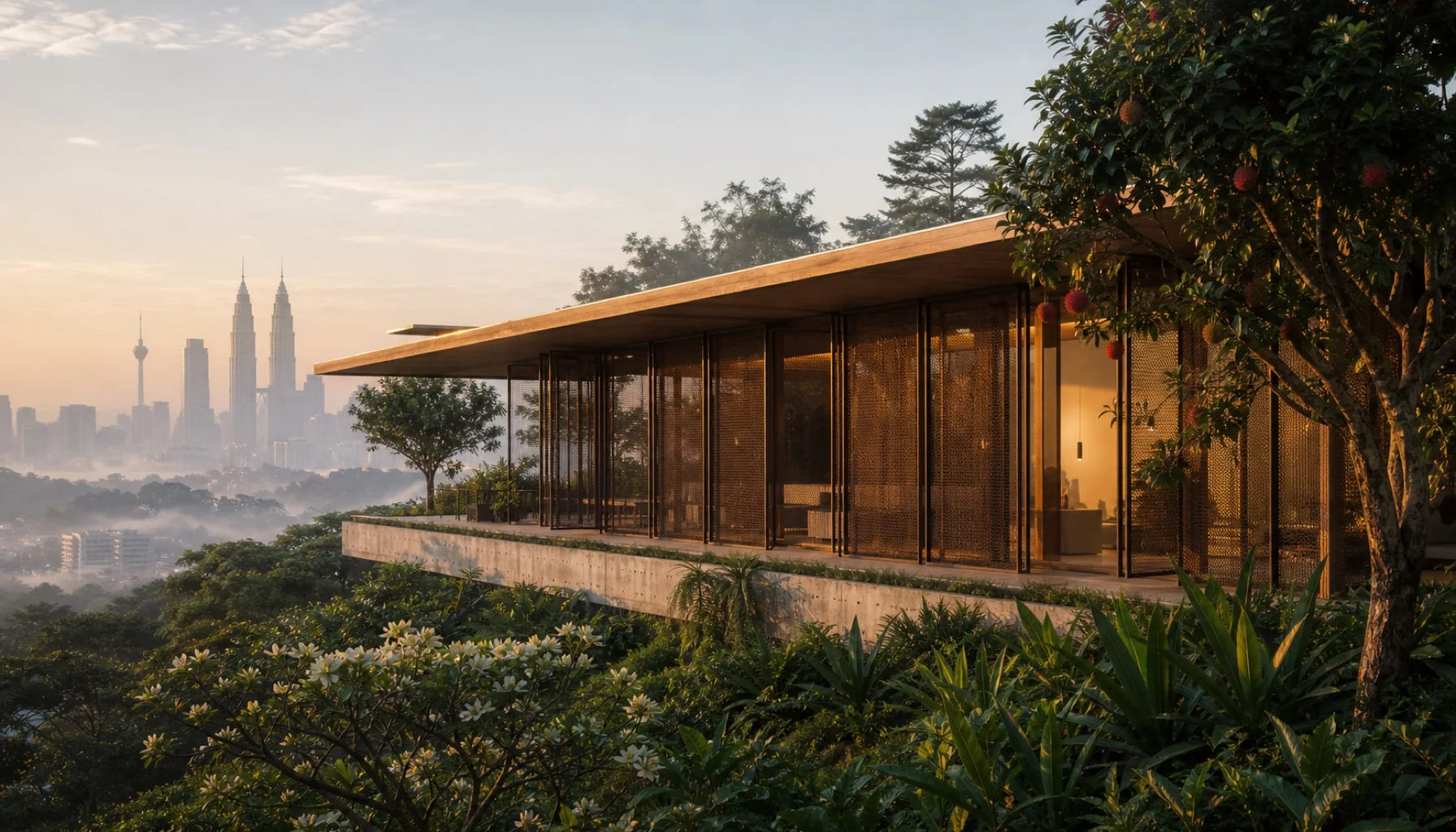
Bukit Tunku Residence.
Kuala Lumpur, Malaysia
A 920 m² single-storey house on the Bukit Tunku ridge above Kuala Lumpur. A deep cross-laminated-timber roof projects over a concrete base cut into the hillside, while full-height bronze-mesh-screened glass opens the living floor to the east. Naturally ventilated year-round, the house looks toward the Petronas Towers through morning mist.
§ DWG-012 · the building
A house for moving air.
The site is a 1.2-hectare hilltop on the Bukit Tunku ridge, the diplomatic quarter west of the Kuala Lumpur city centre, with a clear east-facing view of the Petronas Towers. The Malaysian-Chinese client asked for a single-storey 920-square-metre family house that would not need air-conditioning on the living level, an exacting brief in a city with 78 per cent median annual humidity.
The plan is a long thin rectangle running north-south across the ridge. Morning air enters from the east through continuous bronze-mesh-screened openings, crosses the living rooms, and exits through a high western clerestory. The cross-laminated-timber roof oversails by 4.2 metres on the east face, keeping equinoctial morning sun off the glass. The concrete base is partly embedded in the hillside and works as year-round thermal mass.
The finishes are mostly Malaysian: chengal hardwood floors, lime plaster mixed with local kaolin, and joinery in Burmese teak salvaged from a 1920s shophouse in Penang. Bedrooms sit partly underground in the concrete base. The owner reports air-conditioning use on about thirty nights a year during the hot still nights of the south-west monsoon; the other 335 nights are open windows and a ceiling fan.